

A handmade face cream that costs $6 to produce can still lose money when sold for $18. Packaging, production time, transaction fees, and unsold inventory can quietly consume what looks like a healthy profit.
Understanding how to price handmade skincare products means looking beyond ingredient costs. A sustainable price must compensate you for your work, support future production, and make sense to customers comparing your products with established beauty brands.
The most reliable approach combines accurate cost calculations, realistic profit margins, and market research. Here is how to build a pricing strategy that works for a growing skincare business.
Why Handmade Skincare Pricing Is More Complicated Than It Looks
Unlike mass-produced cosmetics, handmade skincare often involves smaller ingredient orders, manual production, specialized packaging, and limited manufacturing capacity.
A small business producing 50 jars of moisturizer cannot necessarily achieve the same purchasing efficiencies as a company manufacturing thousands.
Pricing too low creates another problem: increasing sales may simply increase your workload without improving your earnings.
The Penn State Extension’s product pricing guidance emphasizes evaluating production costs, financial objectives, customer demographics, and competitor prices together.
Your selling price should reflect both business economics and what customers reasonably expect from your product.
If you’re planning to turn your product idea into a full-fledged beauty brand, explore this guide on how to start a haircare business from home for practical insights into production methods, startup costs, and building a sustainable beauty business.
Calculate the Complete Cost of Each Skincare Product
Before choosing a retail price, calculate your actual production expenses.
1. Measure Ingredient Costs Accurately
Start with the exact quantities required for one batch.
For example, suppose a botanical oil costs $24 for 16 ounces. Its ingredient cost is $1.50 per ounce, before any applicable inbound shipping or taxes.
Repeat this calculation for every ingredient, including preservatives, emulsifiers, fragrance, botanical extracts, and active compounds.
Account for material losses during mixing, transferring, or filling containers. Divide total batch costs by the number of usable products, not the number you originally intended to manufacture.
2. Include Every Packaging Component
Packaging costs extend beyond the visible container.
Calculate expenses for jars, bottles, pumps, caps, labels, tamper-evident seals, protective inserts, and individual product boxes.
A premium glass jar might improve presentation, but it also increases shipping weight and breakage risk.
Compare suppliers using their complete delivered costs rather than advertised unit prices.
Packaging costs also need to account for protecting products during transit, so explore these practical tips on how to ship fragile beauty products safely to reduce leakage, breakage, and shipping-related damage.
3. Pay Yourself for Production Time
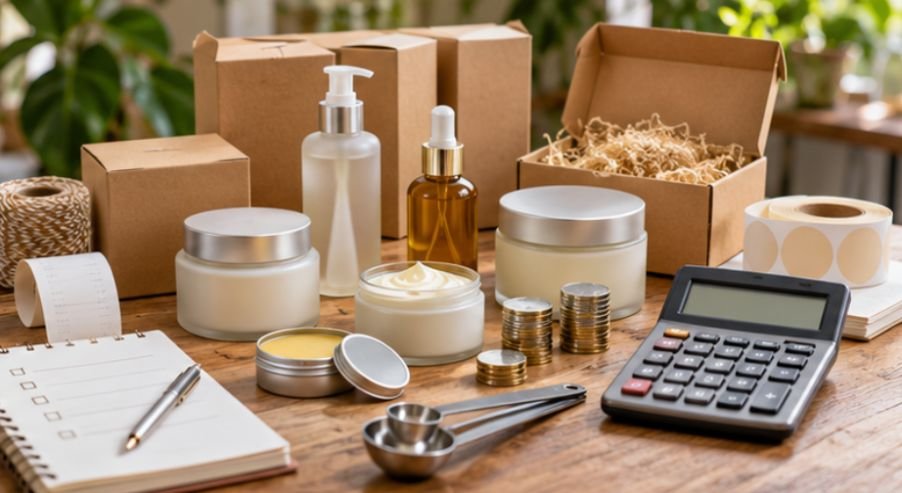
Your labor has measurable economic value, even if you are currently working alone. Track the time spent preparing ingredients, sanitizing equipment, manufacturing, filling, labeling, and cleaning.
Suppose a batch requires five hours and produces 50 jars. At an assumed labor rate of $25 per hour, labor costs $2.50 per jar.
The University of Maine Cooperative Extension’s pricing guidance specifically recommends recording production time and including both labor and overhead when determining handmade product prices.
4. Allocate Business Overhead
Recurring expenses also affect profitability. These can include website subscriptions, insurance, workspace expenses, equipment depreciation, and appropriate portions of testing and compliance costs.
If monthly overhead totals $400 and you expect to produce 200 units, an initial allocation is $2 per unit.
Avoid counting expenses twice. Maintain separate records for manufacturing costs and selling expenses so your pricing calculations remain consistent.
A Practical Handmade Skincare Pricing Example
Consider a small business producing a 2-ounce facial moisturizer.
The following figures are hypothetical and illustrate a complete unit-cost calculation.
| Expense | Cost per jar |
| Ingredients | $3.10 |
| Jar, lid, and label | $1.40 |
| Production labor | $2.50 |
| Allocated overhead | $1.00 |
| Total unit cost | $8.00 |
Now consider several potential selling prices.
| Pricing approach | Selling price | Gross margin |
| 2× production cost | $16 | 50% |
| 3× production cost | $24 | 66.7% |
| 4× production cost | $32 | 75% |
| 5× production cost | $40 | 80% |
These are gross margins calculated against the $8 unit cost, before additional selling expenses.
A $32 retail price appears attractive, but payment processing, promotional discounts, returns, and shipping subsidies can reduce the amount retained.
The takeaway: Multipliers are useful starting points, not guarantees of profitability.
Choose Markup and Profit Margin Carefully
Markup and margin are related but measure different things.
Markup measures profit relative to cost:
Markup = (Selling Price − Cost) ÷ Cost × 100
Gross margin measures profit relative to selling price:
Gross Margin = (Selling Price − Cost) ÷ Selling Price × 100
For an $8 product sold at $24, markup is 200%, while gross margin is approximately 66.7%.
If you want a specific gross margin, use:
Selling Price = Unit Cost ÷ (1 − Target Margin)
For an $8 unit cost and a 70% target gross margin, the required price is approximately $26.67.
These calculations establish a financial baseline. Customer demand determines whether that price is commercially realistic.
Build Wholesale Pricing Into Your Strategy
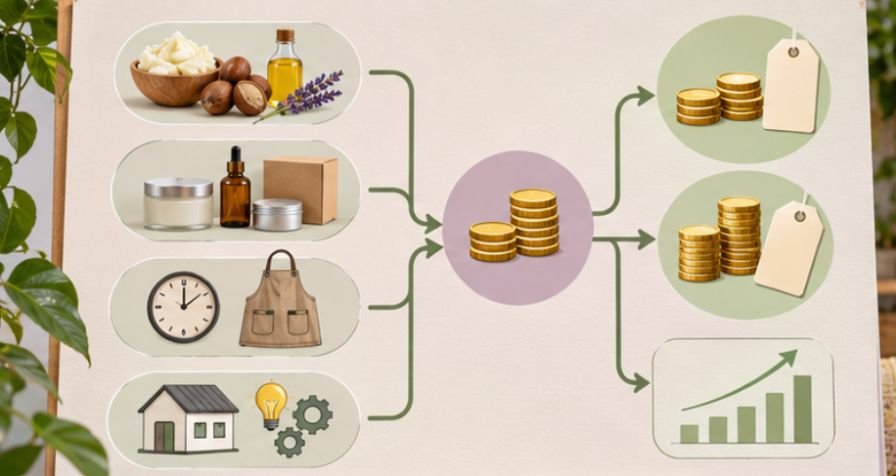
Wholesale opportunities can expand distribution, but retailers need sufficient room to earn their own margins.
Some independent beauty businesses use wholesale prices around 2–2.5 times unit cost and direct retail prices around 4–5 times cost.
These are industry heuristics, not universal requirements.
For example:
- Production cost: $8
- Wholesale price: $16
- Suggested retail price: $32
- Retailer’s gross margin: 50%
At $16 wholesale, your business retains $8 above the allocated production cost before wholesale-specific expenses.
However, retailer discounts, freight, samples, and larger-order requirements can reduce profitability further.
Decide whether wholesale is part of your long-term strategy before establishing retail prices that leave little room for stockists.
Research Competitors Without Copying Their Prices
Competitor research helps establish what customers expect to pay for similar products.
Compare five to ten brands selling comparable formulations through Etsy, independent skincare websites, boutiques, or specialty beauty retailers.
Look beyond the price tag. Evaluate container size, ingredient quality, packaging, brand positioning, and customer experience.
A $38 moisturizer in a premium glass jar is not automatically comparable to a $15 lotion sold in a basic plastic bottle.
Calculate price per ounce when reviewing products of different sizes.
Higher-cost ingredients such as squalane or cold-pressed jojoba may help justify premium positioning, but expensive ingredients alone do not establish superior performance. Customers need a clear, credible reason to pay more.
Account for Safety, Compliance, and Product Claims
Compliance-related expenses are frequently overlooked during early pricing decisions.
The FDA’s homemade cosmetics guidance explains that manufacturers are responsible for ensuring cosmetic products are safe and properly labeled. Certain small businesses qualify for exemptions from specific registration and listing requirements, but not from applicable safety obligations.
Depending on the formulation, expenses may include stability evaluations, microbiological testing, packaging compatibility assessments, and professional advice.
Water-containing products deserve particular attention to microbial safety. Marketing claims also matter. The FTC’s advertising guidance requires advertising claims to be truthful and supported by evidence.
Claims suggesting that a product treats acne, eczema, or other medical conditions may also trigger drug-related regulatory requirements. Budget for compliance before committing to a low selling price.
Test Whether Your Price Supports a Real Business
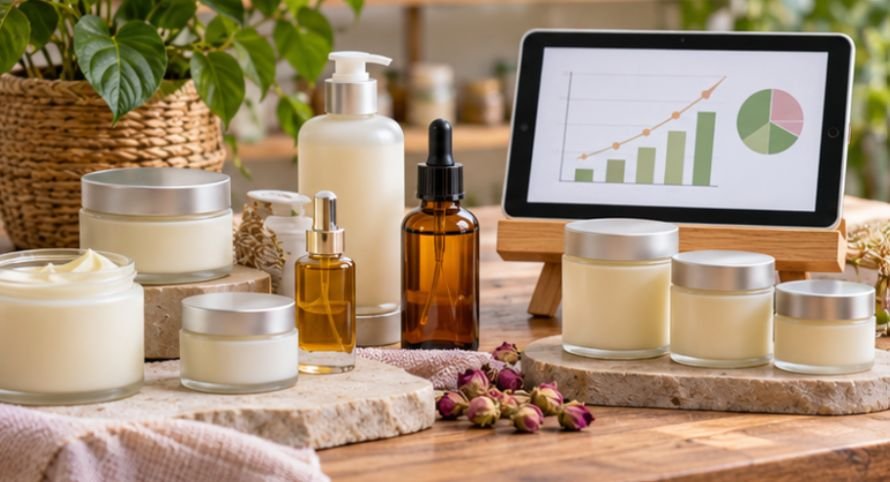
A profitable unit does not automatically mean a profitable business.
The Small Business Administration’s break-even calculator uses this formula:
Break-even units = Fixed Costs ÷ (Selling Price − Variable Cost per Unit)
For example, with $300 in monthly fixed expenses, a $32 selling price, and $12 in variable costs, you would need to sell 15 units to cover those costs.
Before launching, perform three additional checks:
- Discount test: Can you offer a 10% promotion without sacrificing your desired earnings?
- Ingredient increase test: What happens if supplier costs rise 15%?
- Sales volume test: Can your realistic monthly production and sales cover fixed expenses?
Review prices whenever material costs, production methods, or sales channels change.
Common Pricing Mistakes Worth Avoiding
Several habits can undermine an otherwise promising skincare business. Charging only for ingredients ignores labor and infrastructure. Matching inexpensive mass-market products overlooks major differences in production scale.
Another mistake is offering free shipping without incorporating its financial impact.
Excessive discounts can also train customers to wait for promotions rather than purchase at regular prices.
Finally, remember that pricing spreadsheets are management tools. Tax accounting may categorize expenses differently, so use appropriate accounting guidance when preparing financial records.
Frequently Asked Questions
1. What is a good profit margin for handmade skincare?
There is no universal ideal. Some brands target 60–80% gross margins on direct retail sales, but sustainable targets depend on production costs, selling fees, competition, and overhead.
2. Should handmade skincare products cost more than store-bought products?
They sometimes should. Smaller production runs, specialized ingredients, manual labor, and packaging expenses can justify higher prices when customers recognize corresponding value.
3. How often should I update my skincare product prices?
Review costs quarterly and whenever suppliers, shipping rates, packaging, or manufacturing processes change. Adjust prices when meaningful cost increases threaten your target margins.
4. Can I sell handmade skincare products without expensive packaging?
Yes. Simple, functional packaging can reduce expenses while protecting product quality. Prioritize compatibility, safety, labeling compliance, and durability over decorative features.
Price for the Business You Want to Build
Learning how to price handmade skincare products is ultimately about making each sale financially worthwhile.
A low price might attract attention, but it cannot sustain a business that consistently underpays its owner or struggles to replace inventory.
Start by calculating every production expense. Add a reasonable profit target, investigate comparable brands, and test whether your customers will accept the proposed price.
Review actual results after launching rather than assuming your first calculation is permanent.
A successful skincare brand does not need to be the cheapest option available. It needs prices that customers understand, products they trust, and enough profitability to keep improving.