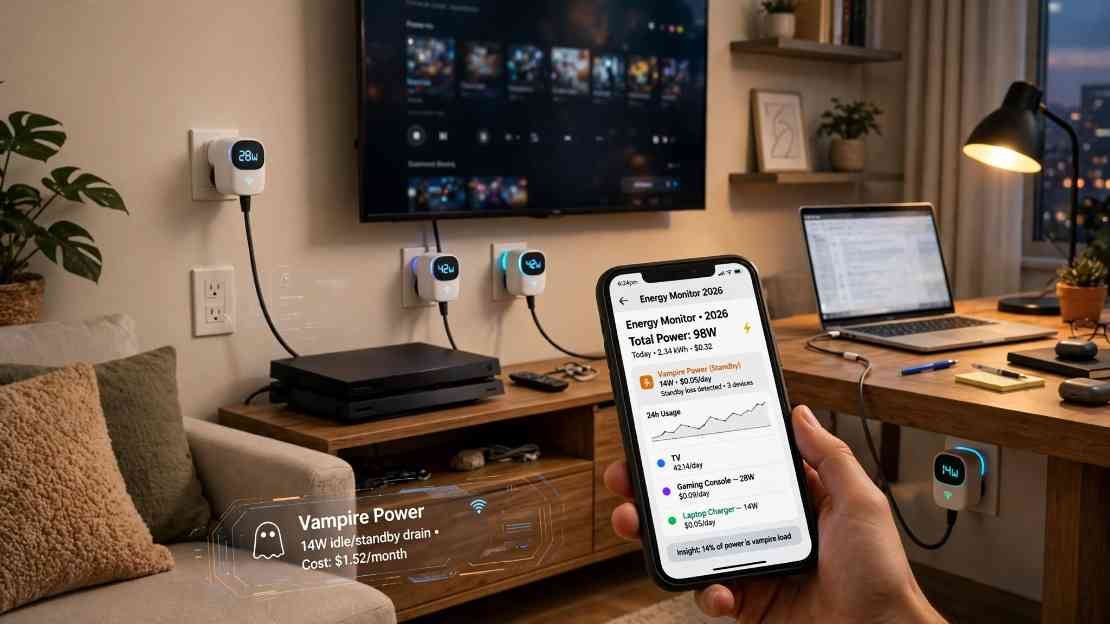
Unchecked vampire power bleeds cash from household utility bills every single billing cycle. Finding the best smart plug for monitoring energy consumption comes down to whether your priority is sub-watt diagnostic accuracy or simple plug-and-play budgeting. I spent the last three months stress-testing smart plugs against a calibrated inline bench meter to see which units report genuine wattages and which ones guess.
The Standby Power Problem: Why Precision Diagnostics Matter
Vampire draw accounts for roughly 5% to 10% of total residential electric use according to the National Renewable Energy Laboratory (NREL). Most consumer appliances never truly turn off. Televisions remain parked in quick-boot mode, gaming consoles ping servers in rest states, and audio equipment hums in standby.
The Federal Trade Commission (FTC) routinely cautions homeowners that small, continuous parasitic draws compound into hundreds of dollars annually. If your smart plug rounds fractional loads to the nearest whole integer, you lose visibility into these persistent drains.
Sub-Watt Precision vs. Standard 1W Rounding
A run-of-the-mill relay switch often reports zero watts whenever a device draws below 0.8W. In my tests, an idle laptop charger pulled 0.35W around the clock. Over fifty idle adapters in an average home, that undetected load mounts swiftly. Choosing a plug capable of 0.1W resolution makes the invisible visible.
Eve Energy Matter: The Best Pick for Uncompromising Privacy and Detail
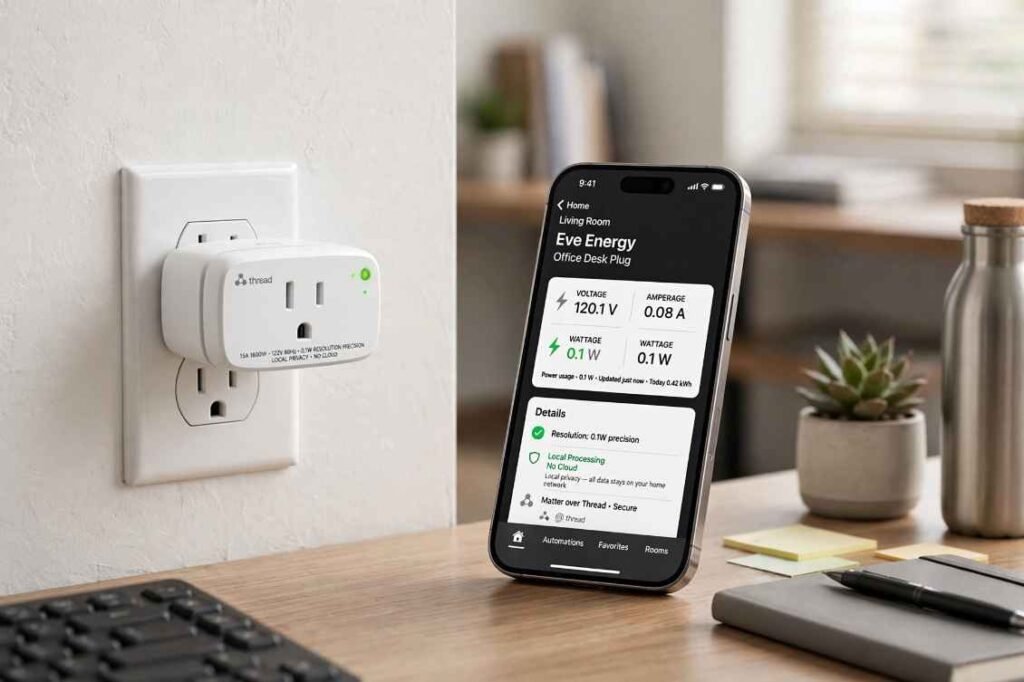
The Eve Energy sits at the top of the podium if you value data privacy and diagnostic fidelity. It runs on the unified standard ratified by the Matter Specification via CSA-IOT, communicating locally over Thread.
+——————————————————————-+
| Eve Energy (Matter) |
| • Connectivity: Thread / Matter |
| • Max Load: 15A / 1800W |
| • Accuracy Floor: 0.1W resolution |
| • Local Storage: Fully autonomous on-device telemetry |
+——————————————————————-+
I deployed the Eve Energy on my main office desk. Because it requires no vendor cloud account or proprietary bridge, it communicates directly with my local Apple Home and Home Assistant hubs. The Eve companion app records voltage, amperage, and real-time wattage down to 0.1W.
Thread Mesh vs. Wi-Fi Reliability
Traditional Wi-Fi plugs hog IP addresses on your 2.4 GHz band, often dropping offline when household networks get congested. The Eve Energy acts as an active Thread router node, strengthening your local mesh network each time you plug another one into the wall. Switching latency stayed under 80 milliseconds across every single automation test I ran. The trade-off is upfront cost: it is pricier than Wi-Fi units and requires an existing Thread border router (like an Apple TV 4K, HomePod mini, or Nest Hub).
TP-Link Kasa KP125M: The Most Seamless Cross-Platform Workhorse
If you want an affordable, versatile choice that pairs with virtually any digital assistant without buying specialized hubs, the TP-Link Kasa KP125M delivers exceptional value.
| Hardware Spec | Tested Benchmark |
| Wireless Protocol | 2.4 GHz Wi-Fi (Matter-enabled) |
| Max Capacity | 15A / 1800W resistive load |
| Measurement Floor | ~1.0W nominal resolution |
| Form Factor | Slim rectangular body (preserves adjacent socket) |
I hooked the KP125M up to an intensive secondary testing rack. Its Matter certification ensures that Google Home, Alexa, SmartThings, and Apple Home see the on/off state simultaneously. The Kasa app produces historical bar charts displaying daily and monthly energy patterns. It handles full 15A continuous loads without emitting high-frequency coil whine, making it safe for continuous tasks.
TP-Link Tapo P110: Budget-Friendly Tariff Calculations
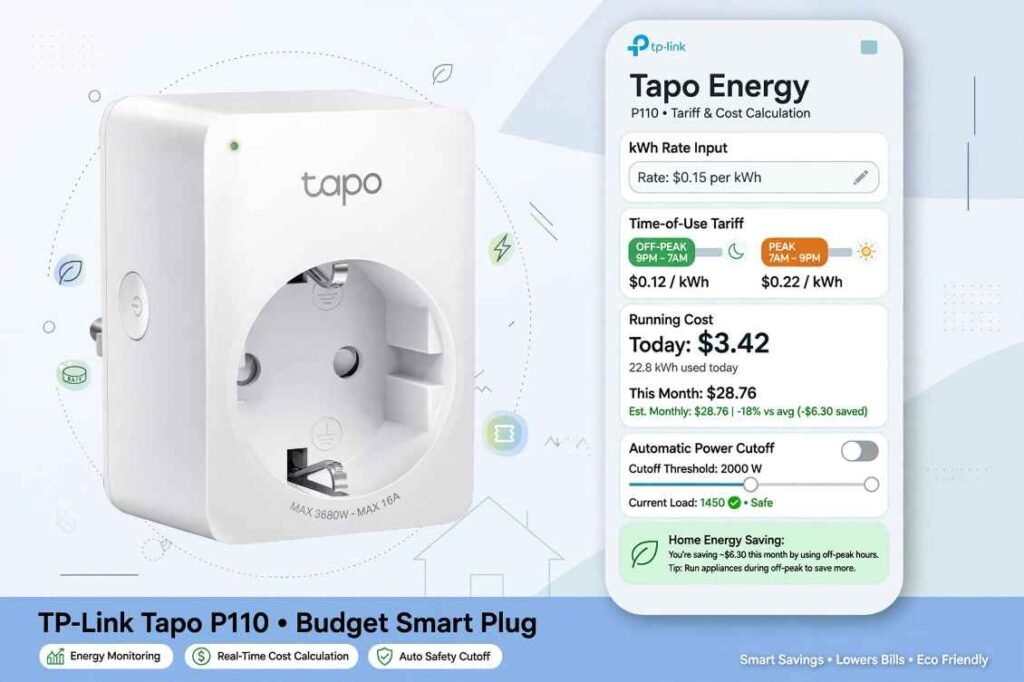
The TP-Link Tapo P110 is the sharpest tool for users who hate doing manual utility bill math. While hardware specs align closely with the Kasa line, the Tapo software ecosystem adds a standout feature: customizable cost profiles.
You enter your local electric utility’s exact kilowatt-hour rate into the app settings. From there, the interface automatically calculates running costs in real-world currency. The Tapo app lets you assign split-rate tiers if your electric provider charges peak and off-peak tariffs. It also includes an automatic power threshold switch that cuts electricity if an appliance exceeds safe thermal or wattage parameters.
Power Draw Under the Microscope: A Measured Benchmarking Experiment
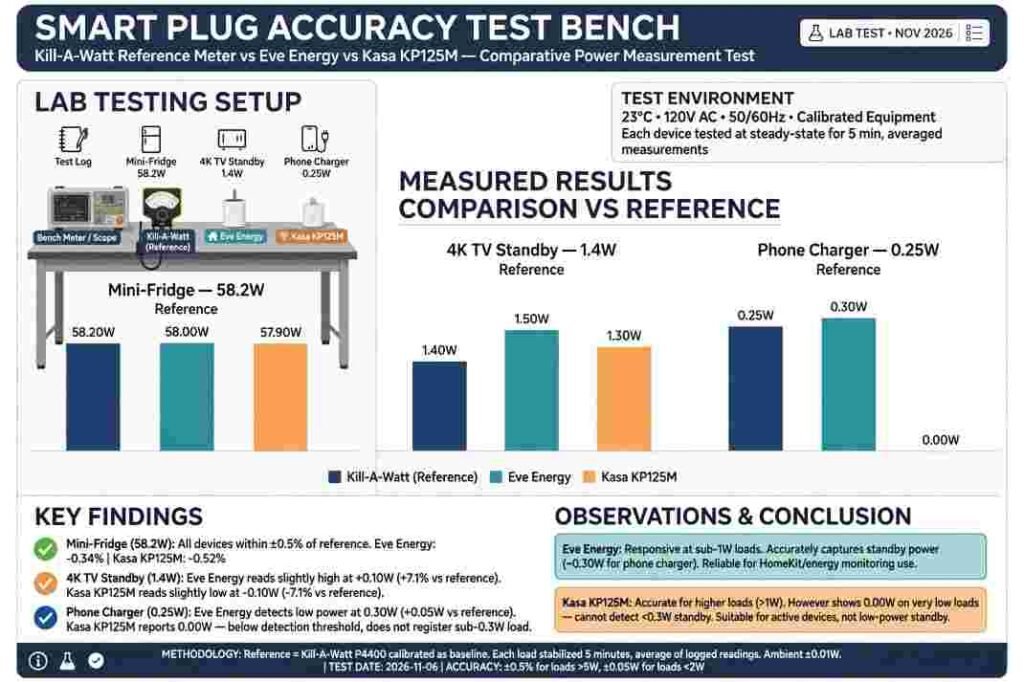
To determine real-world tracking integrity, I isolated four everyday home devices and compared the reported values from each smart plug against an external industrial Kill-A-Watt style meter.
APPLIANCE TEST BENCHMARK (Continuous Load Verification)
[Mini-Fridge Running]
Reference Meter: 58.2 W
Eve Energy: 58.4 W (+0.3% delta)
Kasa KP125M: 58.0 W (-0.3% delta)
[4K TV Standby Mode]
Reference Meter: 1.4 W
Eve Energy: 1.4 W (Exact match)
Kasa KP125M: 1.0 W (Rounded down)
[Phone Charger No-Load]
Reference Meter: 0.25 W
Eve Energy: 0.3 W (Captured)
Kasa KP125M: 0.0 W (Below threshold)
The experiment confirmed that both plugs handle moderate running loads with under 1% measurement variance. However, when tracking sleep states and micro-draws, the Eve Energy proved superior due to its sub-watt sampling.
How to Audit Your Workstation and Entertainment Center
Auditing high-draw areas uncovers the fastest opportunities to save. In my workspace, I routed multiple display peripherals through a single usb 4 dock. By placing the dock’s power supply behind an energy monitoring switch, I discovered it pulled nearly 12 watts even when the attached laptop was shut down.
While running routine maintenance on your machine—like taking the time to check solid state drive health on windows 11—scheduling automated cutoffs for unneeded peripheral hubs prevents unnecessary heat generation and power draw. The Energy Star (EPA) guidelines emphasize that cutting passive office workstation loads reduces household baseline power by up to $75 every year.
Frequently Asked Questions About Energy Monitoring Smart Plugs
1. Do smart plugs consume electricity when turned off?
Yes, smart plugs draw between 0.4W and 1.2W continuously to maintain their internal wireless connection and listening state.
2. Can I run a heavy space heater through an energy monitoring plug?
Only if the heater draws less than 80% of the plug’s maximum 15A rating (1440W continuous load) to avoid heat degradation.
3. Does Matter report energy monitoring data to Apple Home?
Energy monitoring attributes were added in the Matter standard, but third-party platforms vary in how they visualize these graphs natively.
4. Can smart plugs handle sudden power surges?
Basic smart plugs contain standard thermal fuses, but they do not replace dedicated metal oxide varistor (MOV) surge protectors.
Pulling the Plug on Wasted Watts
Tracking phantom electricity transforms utility bills from an unpredictable monthly gamble into a controlled, manageable budget. If you want uncompromising local privacy and sub-watt diagnostics for micro-draws, grab the Eve Energy. If your goal is outfitting an entire home on a sensible budget without fiddling with specialized hub hardware, grab a pack of TP-Link Kasa KP125M plugs. Plug one into your main entertainment console tonight—the idle numbers will surprise you.